Article Summary
- Most course marketing sounds identical – every stock trading course promises to teach you to trade profitably, which is why reviewing curriculum structure and specific content rather than testimonials is the only reliable way to differentiate between them.
- Risk management coverage is the single most important criterion – a course that treats risk as a footnote rather than a core subject is not preparing you for how real markets behave, regardless of how strong the rest of the content is.
- Theory without practice does not produce execution readiness – traders who study chart patterns and strategies but never practise placing trades in a simulated environment are unprepared for the psychological pressure of live decision-making.
- Live sessions are fundamentally different from pre-recorded content – watching a professional trader analyse a live chart and field real questions is a different educational experience from watching an edited video of the same process.
- A course is the beginning of trading education, not the end of it – the gap between completing a course and trading confidently in live markets is real, and courses that acknowledge this honestly rather than promising immediate profitability are the ones worth trusting.
You have three tabs open. Three stock trading courses, all with hundreds of five-star reviews, all promising to teach you how to trade the stock market confidently and profitably. The curriculum headings look similar. The prices are different but not radically so. One has a celebrity instructor. One has a money-back guarantee. One has been recommended in a forum you trust. You have no clear basis for choosing between them.
This is the problem that most course comparison articles fail to solve. They list features rather than criteria, which leaves you knowing more about the courses but no better equipped to decide which one is right for you. What follows is a five-part framework – ranked by importance – that you can apply to any stock trading course before you hand over your money or your time.
What “Stock Broker Course” Actually Means – and What You Are Really Looking For
Before going further, it is worth being clear about what this article covers. The phrase “stock broker course” can mean different things to different people. Some people search it looking for a course to become a licensed stock broker or securities professional – a regulated career path that involves licensing exams and is not covered here. Others use it as shorthand for a stock trading course: a programme that teaches retail investors and traders how to buy and sell stocks, ETFs, and other financial instruments in their own accounts, for their own benefit.
This article is for the second group. If you are figuring out where to start as a retail trader, or you are looking to build on early experience with a more structured programme, the criteria below apply directly. Everything that follows uses “stock trading course” as the precise term.
What a Good Stock Trading Course Should Actually Cover
A baseline curriculum for any serious stock market trading course should cover how financial markets work, what stocks, ETFs, mutual funds, and bonds actually are, how a brokerage account operates, and how to read and interpret price charts. This is the foundational layer, and without it, more advanced content on technical analysis and trading strategies has nothing to attach to.
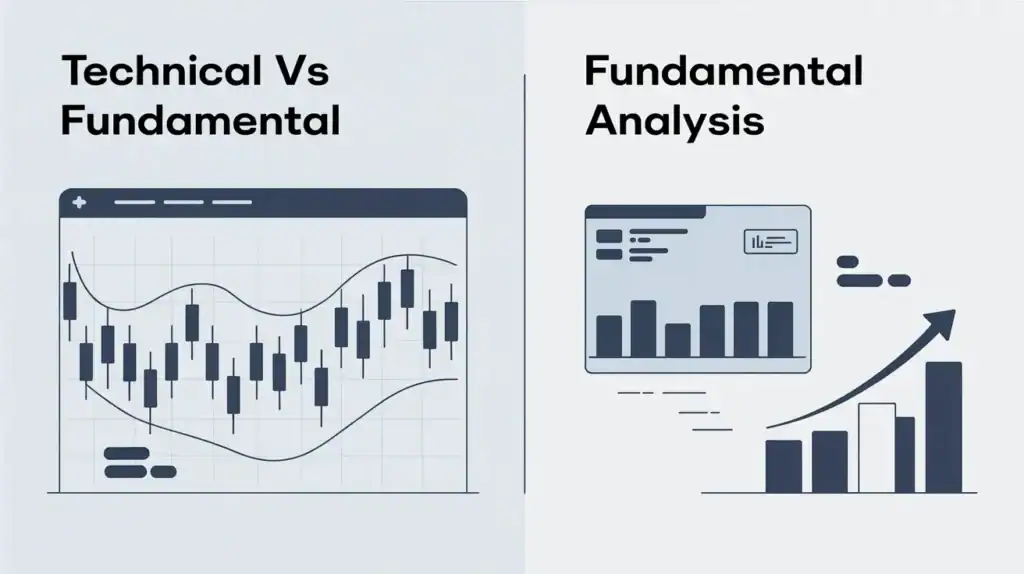
From there, the curriculum should build into fundamental and technical analysis – understanding how to assess a company’s financial health alongside how to read chart patterns and indicators like the RSI. Trading strategies come next: the course should introduce multiple approaches, covering day trading, swing trading, and longer-term stock investing, so that learners can identify the style that fits their temperament, time availability, and risk tolerance rather than being pushed into one default approach.
The 2020 and 2021 boom in retail trading accounts showed what happens when this curriculum is compressed or skipped. Millions of beginner investors opened brokerage accounts during that period, many of whom enrolled in online courses that were theory-heavy but lacked any structured practice environment. When markets became volatile in 2022 and the easy uptrend conditions that had made trading feel simple disappeared, the gap between theoretical knowledge and actual execution readiness became clear. Understanding what a moving average is and knowing when to act on one under real-time pressure are different skills, and a good course builds both.
The Criteria That Matter Most When Choosing a Trading Course
Curriculum depth and progression is the first criterion to assess, and the structure matters more than the content list. A well-designed stock trading course starts with the essentials, builds progressively toward more complex material, and connects each concept to a practical application rather than treating knowledge as an end in itself. Look at the course outline and ask: does each section build on the previous one in a logical sequence? If the intermediate material could be taught before the beginner material without loss of clarity, the curriculum lacks genuine progression.
Risk management coverage is the criterion that most clearly separates serious courses from superficial ones. Risk management is not a single module – it is the thread that should run through every section of a good course. How much to risk per trade, how to size positions, how to place stop-losses, how to calculate the risk-reward ratio before entering any trade, and how to protect your capital during a drawdown are not advanced topics reserved for experienced traders. They are foundational. A course that introduces risk management as a late-stage topic, or covers it in a single hour alongside position sizing, is not treating it with the seriousness that live trading demands. This is the single criterion where there should be no compromise.
Hands-on practice environment is where most online courses, including many popular options on Udemy and free resources available on YouTube, have a genuine gap – and where it is worth being honest about the trade-off. Self-paced online courses have real advantages: they are flexible, often significantly cheaper, and allow learners to move at their own pace without the scheduling constraints of live instruction. For traders with strong self-direction and the discipline to practise independently, these are legitimate choices. What they typically cannot provide is a structured simulated trading environment – a setting where the learner practises placing actual orders, managing positions, and making real-time decisions without risking real money. That gap matters more than most course descriptions acknowledge.
Live market sessions and instructor credibility address a different dimension of quality. Pre-recorded video content can teach concepts clearly, but it cannot replicate the experience of watching a professional trader work through a live chart, explain their reasoning in real time, and respond to questions as conditions change. Ask whether the course includes live sessions before you enrol – and if it does, ask to see a sample. Instructor credibility matters here too: a teacher whose knowledge comes from trading rather than solely from teaching about trading brings a different quality of insight to live sessions. Look for evidence of a verifiable trading background, not just educational qualifications.
Ongoing support and mentorship is the criterion most frequently promised and least consistently delivered. Many courses describe access to a community, a forum, or a mentorship element that turns out to be a generic message board with infrequent instructor involvement. Genuine mentorship – structured feedback on your trades, direct access to experienced traders, and a framework for reviewing your progress over time – is valuable precisely because it continues after the formal course content ends. Before enrolling, find out specifically what post-course support looks like and how often instructors are actively engaged with students.
For a complete beginner, criteria 2 and 3 should carry the most weight – a course that is rigorous on risk management and includes structured practice will serve you better than one that is impressive on live sessions but lacks the foundational depth. For a trader with some experience who is trying to move from inconsistent to consistent results, criteria 4 and 5 matter most: live sessions and structured mentorship provide the feedback loop that self-paced learning cannot.
Why Hands-On Practice and Simulated Trading Change Everything
Rachel is a nurse from Birmingham who had wanted to learn stock market trading for two years before she finally enrolled in a highly rated online course. The course was thorough on theory. She understood how to read candlestick charts, how moving averages worked, and how to identify support and resistance levels. She scored well on every assessment. She completed the course in seven weeks.
Her first morning in front of a live trading platform, she froze. The order panel was open. The chart looked different from the clean, annotated examples in the course materials – noisier, faster, less obvious. She was not sure how to size her position. She was not sure whether what she was looking at was a valid setup or just a pattern she was hoping to see. She closed the platform without placing a trade and spent the next three weeks watching rather than trading, paralysed by the gap between what she had learned and what she was now expected to do.
The course had not failed her on knowledge. It had not given her any practice at the point of decision – the moment when a setup appears, time pressure builds, and the money feels real even before you have committed to anything.
Paper trading, also called simulated trading, bridges exactly this gap. It means executing trades on a live market using a practice account, so that the mechanics of order placement, position management, and exit decisions are practised under realistic conditions before any real money is at stake. A stock trading course that includes a structured paper trading component is not offering a minor extra feature. It is addressing the most common failure mode for new traders.
If you want to build this kind of execution practice before or alongside a structured course, the Olix Academy Trading Simulator lets you trade against live market data without risking real capital – the closest available environment to live trading that does not carry live financial consequences.
Instructor Credibility, Live Sessions, and Ongoing Support
The quality of live sessions in a stock trading course depends almost entirely on the quality of the people running them. An instructor who has spent years as a professional trader in real financial markets, managing real risk with real capital, brings a different dimension to live chart analysis than someone whose expertise is primarily educational. This does not mean academic or analytical knowledge is worthless – understanding how markets work theoretically is valuable. But trading involves decision-making under uncertainty and pressure, and instructors who have experienced that themselves teach it differently from those who have only studied it.
When assessing whether a course offers genuine mentorship rather than a labelled community forum, look for specific structures: weekly or monthly trade reviews, direct instructor feedback on student trade logs, or live Q&A sessions focused on student trades rather than pre-prepared content. These elements are costly for course providers to deliver, which is why genuine mentorship is rare and why courses that claim it deserve scrutiny before you take the claim at face value.
The Honest Truth About What a Course Can and Cannot Do
Consider the trader who completed a genuinely rigorous stock trading course – one that met every criterion above – studied carefully, passed the assessments, and understood the material. Six months into live trading, they had lost money on more trades than they had won. Not because the course was inadequate, and not because they had stopped following their rules. But because the mental experience of watching a losing trade sit open, in a real account, with real money attached, is not a feeling that any course can fully prepare you for in advance. The competence built in a structured learning environment had not yet been stress-tested by consecutive live losses, real drawdowns, and the doubt that follows them.
This is not a reason to avoid taking a course. It is a reason to choose one with clear expectations. A trading course should give you a foundation: the knowledge to understand what you are looking at, the framework to manage your risk, and the practice environment to build execution habits. What it cannot give you is the experience itself. That comes from time in markets, from keeping a trade journal through losing streaks as well as winning ones, and from gradually developing the self-control to follow a trading plan when every instinct is pulling against it.
Checking that any brokerage platform recommended within a course operates under regulatory oversight – and that any funds held with that broker have protections in place, as covered by bodies like the Securities Investor Protection Corporation in the US or the FSCS in the UK – is also a sensible step before committing to a programme that is tightly linked to a specific brokerage platform.
If you want to build that foundation within a structured programme that addresses all five criteria above, Olix Academy’s Stock Trading Course covers stock market fundamentals, technical analysis, trading strategies, risk management, and building a trading plan across five structured modules. Whether a structured programme with live sessions is how you learn best – or whether you’re the kind of person who makes more progress working independently – is worth thinking through before you commit to anything.
The programme runs over 8–12 weeks with live trading sessions alongside professional traders. For complete beginners who want to start from the very foundations of financial markets, the Beginner Trading Course provides that entry point. 92% of students who complete the Olix Academy programme become profitable within their first six months – a result that reflects the combination of structured curriculum, live practice, and ongoing feedback, not any single component alone.
Frequently Asked Questions
What is the best stock trading course for beginners?
The best stock trading course for a beginner is one that prioritises risk management as a core subject from the start, includes a simulated trading environment for practice, and is taught by instructors with verifiable trading backgrounds. Beginners are often drawn to courses based on price or promise of rapid results – both are unreliable signals of quality. A course that is honest about the time it takes to develop genuine trading skill, and that builds that skill incrementally rather than front-loading theory, will serve a beginner investor better than one that moves quickly to advanced content before the foundations are secure.
Are trading courses worth it?
Yes, with conditions. A well-structured stock trading course that covers risk management, includes hands-on practice, and provides access to live sessions compresses the learning curve significantly compared to self-directed learning through free resources. The caveat is that the quality difference between courses is large. A theory-heavy course with no practice environment and no structured feedback may be less valuable than a free set of well-chosen YouTube tutorials combined with disciplined paper trading. The criteria in this article are the basis for distinguishing between them.
Does a good trading course need to include live market sessions?
Live sessions are highly valuable but not strictly required for a course to be worth taking. What matters more is whether the course includes some mechanism for applying knowledge in real-time – whether that is a structured paper trading component, access to a trading simulator, or live Q&A sessions where students can bring their own trades for review. Pre-recorded content can teach concepts with precision, but learning to make trading decisions under real-time conditions requires active practice, not passive watching. A course that has both strong recorded content and live market analysis covers both dimensions.
How do I know if a course covers risk management properly?
Look at where risk management appears in the curriculum structure. If it is covered in a single dedicated module late in the course, or if it is described in marketing materials but absent from the detailed syllabus, treat it as a warning sign. Strong risk management coverage appears throughout a course – in how position sizing is introduced, in how every trading strategy is taught alongside stop-loss placement, and in how course content addresses drawdowns and losing streaks as expected features of trading rather than exceptions. Ask specifically whether the course teaches you to calculate risk-reward ratios before entering trades, not just after reviewing them in retrospect.
Should I choose an online course or in-person trading classes?
Both can be effective, and the choice depends more on how you learn than on which format is inherently superior. In-person trading classes or live online sessions offer real-time interaction, immediate feedback, and the accountability of showing up to scheduled sessions. Self-paced online courses offer flexibility, typically lower cost, and the ability to revisit content at your own pace. The most important factor is whether the format gives you access to live practice and structured feedback – whichever format delivers those two things most consistently is the one that will produce better results for your specific learning style.
What is the difference between a stock broker course and a stock trading course?
A stock broker course, strictly defined, is a training programme designed to prepare candidates for a professional stock broker licence or securities industry qualification – typically including regulatory examinations and compliance training. A stock trading course is a programme for retail traders and investors who want to learn to trade their own accounts. The vast majority of people searching for a “stock broker course” are looking for the second category. This article covers stock trading courses for retail market participants, not professional licensing pathways.
Most people choose a trading course based on how confident it makes them feel before they start. The courses worth choosing are the ones that are honest about how the process actually works once you are inside it.